Why This Page Exists
The semiconductor information published on this site is not simply “data collected from somewhere.”
It is based on paper databooks collected over 40+ years, out-of-print specification tables and cross-reference guides, 2,700 types comprising 300,000 physical devices, and data I’ve measured myself.
This page explains the source materials behind kaz-electro.jp. In particular, I’ll introduce “CQ Publishing Company” in detail—a name unfamiliar to readers outside Japan.
CQ Publishing Company — The Heart of Japanese Electronics Culture
Company History and Position
CQ Publishing Company (CQ出版社, CQ Shuppansha) is a Japanese publisher specializing in electronics engineering and amateur radio, founded in 1954.
The company was established in 1954, building upon the foundation of “CQ ham radio” magazine, which had been published since 1946.
In Japan, virtually everyone involved in electronics engineering—whether professional or amateur—knows this company’s name.
Starting with amateur radio publications, the company later expanded into circuit design, semiconductor technology, embedded systems, and many other technical fields.
Major Publications
CQ ham radio (launched 1946)
- Japan’s leading monthly magazine for amateur radio enthusiasts
- Each issue approximately 3cm thick
Transistor Gijutsu / Transistor Technology (launched 1964)
- Monthly technical magazine for professional engineers
- Focus on analog circuit design and measurement techniques
- A treasure trove of technical information that supported Japanese manufacturing
Ham Journal
- Bimonthly magazine covering advanced techniques
- (Ceased publication around the late 1990s)
Interface
- Magazine specializing in microcontrollers and embedded systems
The company also sold numerous specialized books, kits, and development tools.
Why It Was Read by Both Amateurs and Professionals
A distinctive feature of Japan’s electronics engineering community is the low barrier between amateurs and professionals.
- Many professional engineers also enjoyed amateur radio and electronics projects as hobbies
- Engineers from manufacturers contributed technical articles to CQ Publishing magazines
This culture made CQ Publishing not just a “hobby magazine publisher” but the information infrastructure supporting all of Japanese electronics engineering.
Transistor Specification Tables & Cross-Reference Guides — Essential Tools Now Out of Print
What Is a Cross-Reference Guide?
A Transistor Cross-Reference Table (互換表, Gokanpyō) helps you find interchangeable parts among semiconductor devices from different manufacturers.
A Specification Table (規格表, Kikakuhyō) compiles detailed specifications of devices.
Only transistors had both types of publications. The demand was overwhelmingly large.
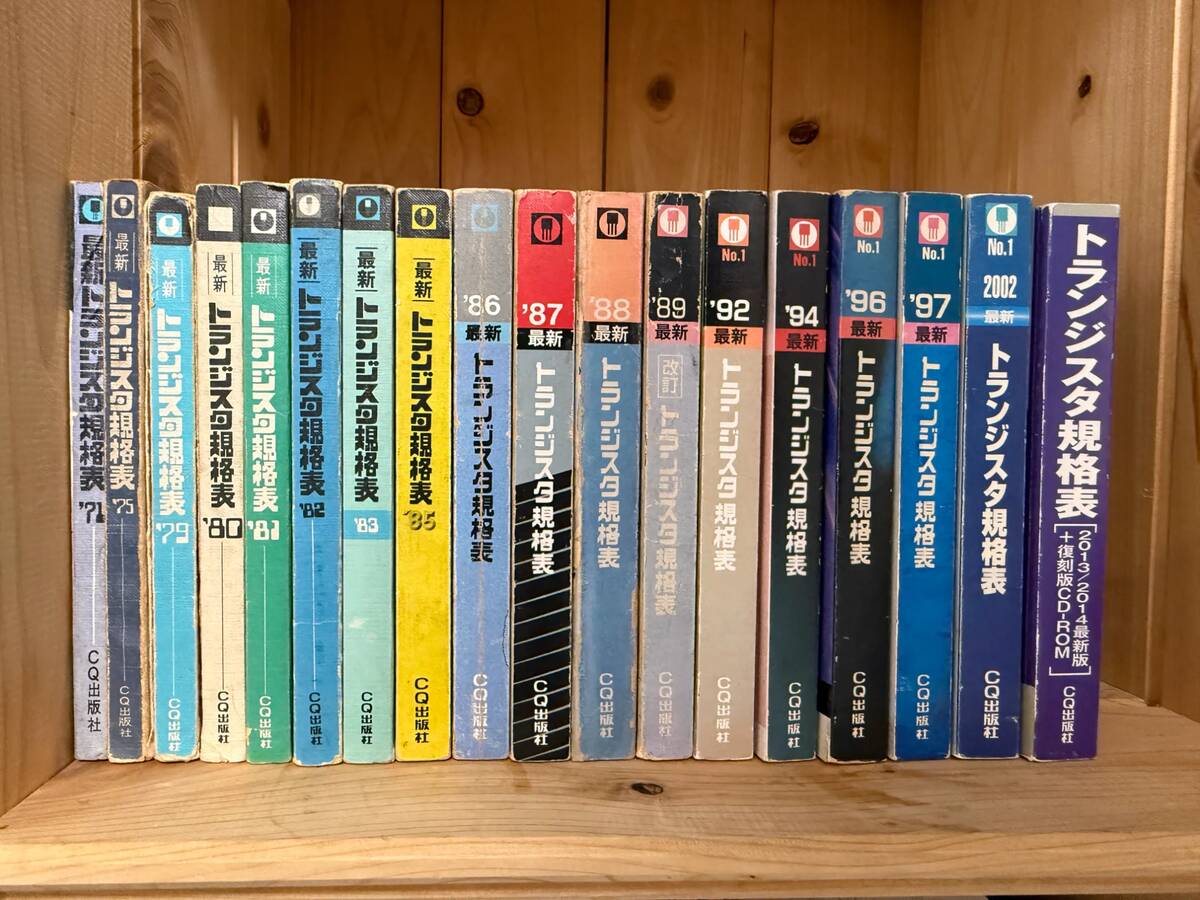
CQ Publishing’s Semiconductor Specification Table Series
From the 1970s through the 2000s, CQ Publishing issued specification tables such as:
- Latest Transistor Specification Table & Transistor Cross-Reference Guide
- Latest Diode Specification Table
- FET Specification Table
- Op-Amp Specification Table
- A-D/D-A Converter Specification Table
- Various other device types
At their peak, 15-20 different specification and cross-reference guides were published annually.
Why They Were Important
In the pre-internet era (before 2000), these were essential tools for professional circuit designers, service technicians, and amateurs alike:
- Checking compatibility between manufacturers
- Finding replacements for discontinued parts
- Cost reduction and procurement flexibility
2022: The Specification Tables Go Out of Print
From the 2000s onward, demand declined with the emergence of online databases, and CQ Publishing gradually reduced specification table publication.
Final editions:
- Latest Transistor Specification Table 2013/2014 edition → Out of print around October 2022
- Latest Diode Specification Table 2013/2014 edition → Out of print at the same time
In other words, since 2022, new CQ specification tables exist only as remaining stock in circulation.
The Special Significance of the 1988 Edition Transistor Specification Table
This particular year’s specification table holds special meaning.
To control the ever-increasing page count, CQ Publishing changed its policy starting with the 1989 edition: only current products would be listed, with discontinued models deleted.
However, data was also enhanced.
The format changed from 1 device per 1 line per 1 page to 1 device per 1 line across 2 pages (spread format), allowing more detailed information to be recorded. The text was also made slightly larger for better readability.
In other words, the 1988 edition became the only and final publication containing complete information from the earliest top numbers like 2SA12, 2SB12, 2SC11, 2SD11 through to the latest models.
The 1988 edition had long been especially popular, but fortunately the final 2013/2014 edition included the 1988 edition as a CD-ROM appendix, so you no longer need to desperately hunt for the original 1988 version.
However, this also means that the 2013/2014 edition lacks information on models that gradually disappeared after 1989. We cannot overlook this “Valley of Information” pitfall (see “Why This Archive Exists” for details).
CQ Publishing Materials Used in This Archive
History of Transistor Specification Tables
October 1965 Issue “Transistor Gijutsu” Supplement
The oldest specification table I own is the supplement from the October 1965 issue. At this time, it was edited by the editorial staff.
This specification table included cross-reference information summarizing equivalent products from domestic manufacturers (NEC, Hitachi, Toshiba, Matsushita, Sony, Sanyo, Kobe Kogyo).
The Era of Tokita Motoaki (1966-1988)
The first edition edited by Tokita Motoaki (時田元昭) was published on March 20, 1966.
In the preface to the 1971 edition, Tokita wrote:
“In some cases, people might search for special devices in the trash of junk shops, so we decided to include all product types.”
“With the exception of prototypes made by transistor manufacturers, all transistors sold commercially must be registered with EIAJ, so this covers practically all domestically available transistors.”
And in his final edition, published June 20, 1988:
“This specification table collects all transistors registered with the Electronics Industries Association of Japan (EIAJ). This includes special-purpose products for NTT and NHK, or products manufacturers made for communications, computers, and other specialized applications. (…) We decided to include all product types to make this specification table available to as many people as possible.”
This consistent policy—”including all products, even special-purpose ones”—is why the specification tables became not just “catalogs of general-purpose parts” but the last bastion of vintage semiconductor research.
1989: The Editorial Policy Shift
With the 1989 edition (published June 30), when editorship passed from Tokita to the editorial staff, the policy changed significantly:
“Until last year’s (’88 edition), this Latest Transistor Specification Table followed all devices registered with EIAJ (Electronics Industries Association of Japan), but starting this year we have revised it to focus primarily on commercially available components (…) to expand its usefulness.”
Specifically:
- EIAJ-registered but not commercially available devices → Deleted
- Not EIAJ-registered but commercially available value-added products → Added
And then, the decisive declaration:
“For this reason, the transistor specification table that included obsolete and discontinued products ends with the ’88 edition.”
This editorial staff system continued until the 2013/2014 edition (final edition), published March 15, 2013.
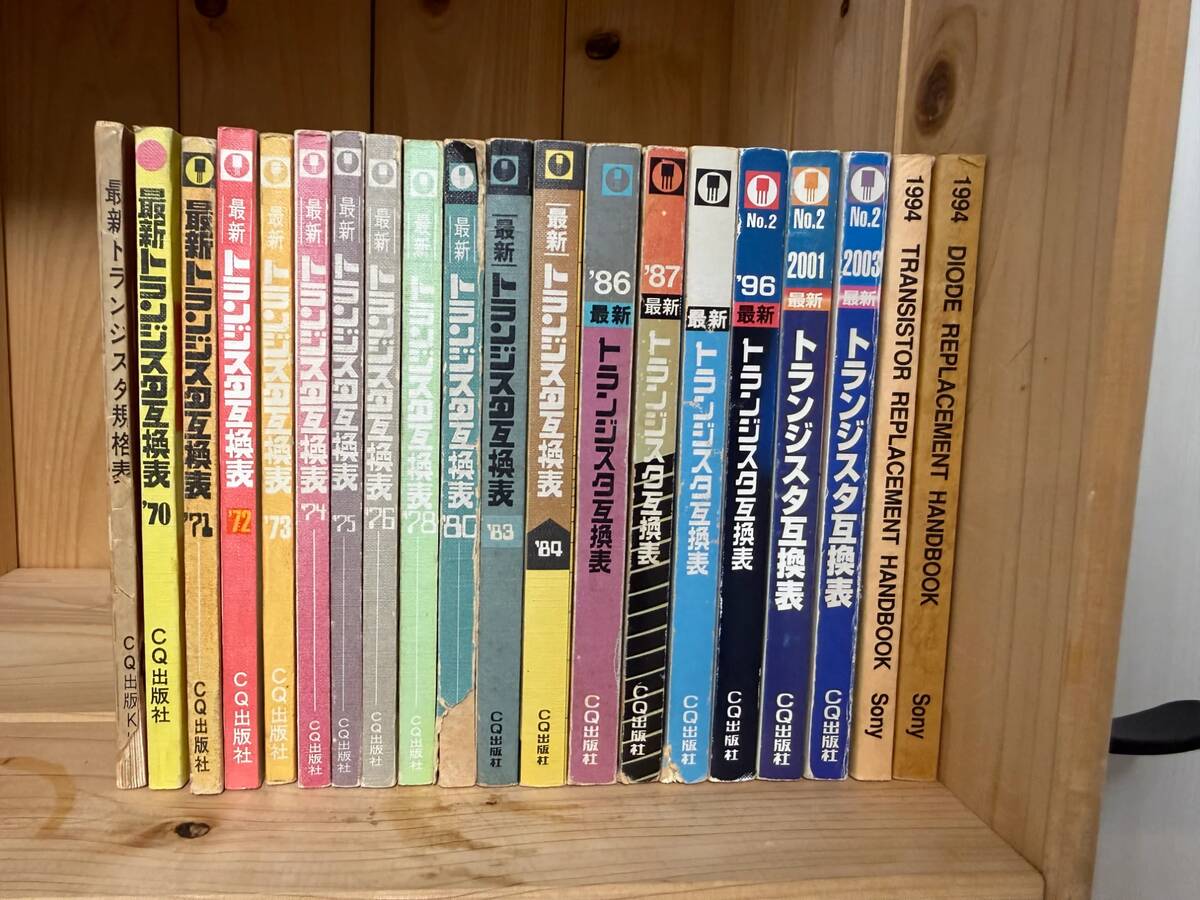
History of Transistor Cross-Reference Guides
January 30, 1968: First edition published (Edited by: Transistor Gijutsu Editorial Staff)
1970 Edition: Listed cross-reference information between overseas products (2N230-2N3148A) and domestic products
This edition contains detailed cross-reference information with Kobe Kogyo, Sanyo, Sony, Toshiba, NEC, Hitachi, Fujitsu, and Matsushita.
1971 Edition onward: Overseas cross-reference information disappeared, leaving only domestic manufacturer cross-references
The manufacturer list also changed, with Mitsubishi added.
1987 Edition onward: Rohm added
1996 Edition: Sony removed, Sanken added
In other words, overseas cross-reference information exists only in the 1970 edition of the cross-reference guide.
(Note: The 1968 first edition and 1969 edition are not in my possession, so the presence or absence of overseas cross-reference information is unknown)
My CQ Publishing Collection
Japan’s Semiconductor Part Numbering System
EIAJ/JEITA Unified Part Numbers (1960s-2000s)
Japanese semiconductor devices had a unified part numbering system:
- 2SA: PNP type, high frequency
- 2SB: PNP type, low frequency
- 2SC: NPN type, high frequency
- 2SD: NPN type, low frequency
This system allowed you to infer basic characteristics from the part number, even across different manufacturers.
I feel that the ability to instantly identify whether a device is PNP or NPN just by looking at the part number is an excellent feature of Japanese transistor nomenclature.
Originally based on the JIS C 7012:1982 standard, after its abolition in 1993, EIAJ (Electronic Industries Association of Japan) took it over, and it is now managed as JEITA (Japan Electronics and Information Technology Industries Association) standard ED-4001A.
Increase in House Number Products (2000s onward)
From the 2000s onward, each manufacturer began using their own proprietary part numbers (house numbers).
Examples: Toshiba’s TK… series, Rohm’s DTA… series, etc.
This made it difficult to understand what a device is at a high level from the part number alone.
Manufacturer-Issued Databooks
From the 1960s through the 1980s, Japanese semiconductor manufacturers published databooks (handbooks) for their products.
An Important Fact
These were written primarily in Japanese only.
While there were cases where technical explanations and brief feature descriptions for each product type were provided in both English and Japanese, the content was primarily in Japanese. Parameter table headings used English abbreviations (hFE, VCE, fT, etc.).
In other words, while some consideration was given so that necessary information could be understood even without knowing Japanese, the basic structure assumed primarily Japanese readers. This would have been a significant barrier for readers outside the Japanese language sphere.
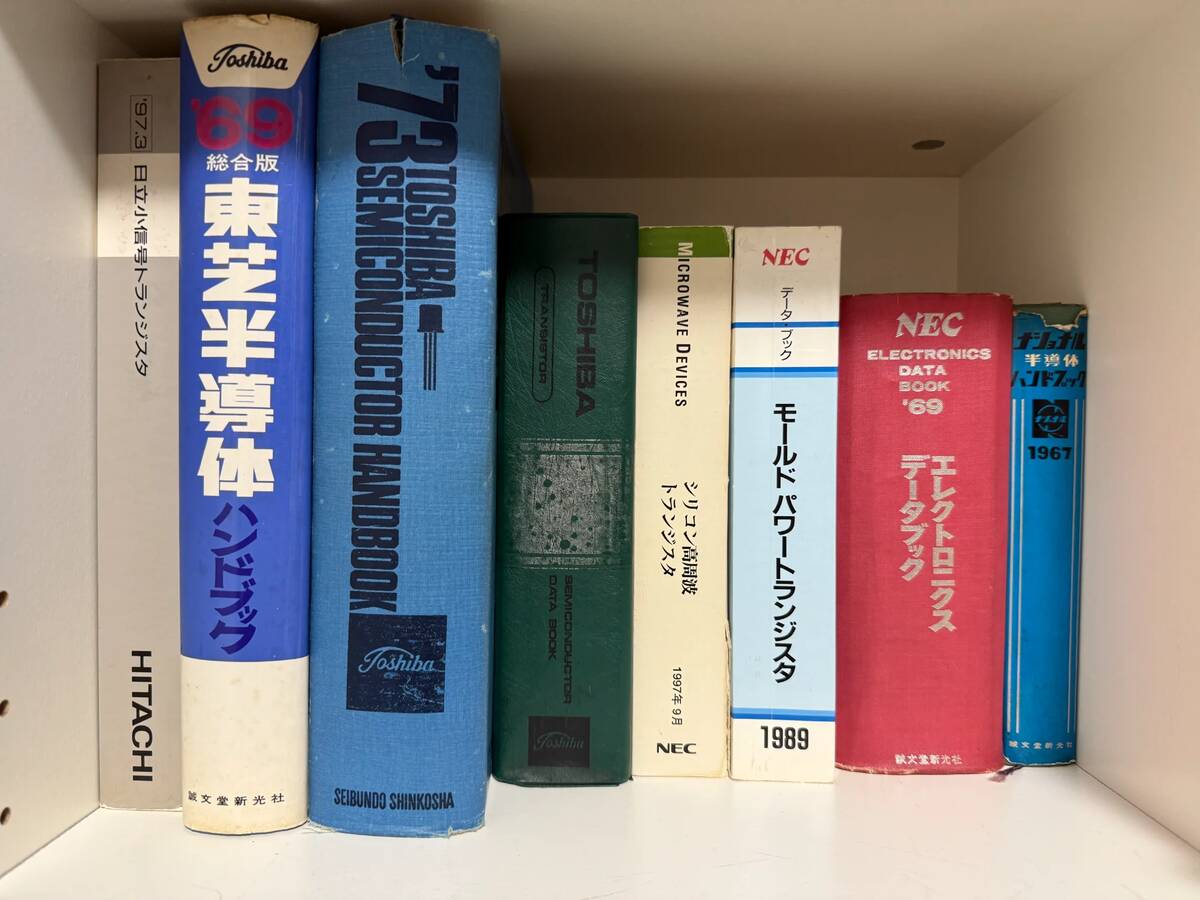
Main Databooks Used in This Archive
Major manufacturer databooks I own:
- Toshiba
- NEC
- Hitachi
- Matsushita (Panasonic)
- Sanyo
- Mitsubishi
- Fujitsu
- Sony
- Others
Note: Details of each manufacturer’s databooks (years owned, acquisition difficulty, characteristics, etc.) will be added after physical verification.
Why Paper Archives Still Matter Today
The Triple Disconnection
Vintage Japanese semiconductor information faces three disconnections:
- Temporal Disconnection: The “Valley of Information” (1990s-2010)
- Linguistic Disconnection: Japanese materials were never translated into English
- Systemic Disconnection: Decline of unified part numbers + CQ specification tables going out of print (2022)
What Makes This Archive Unique
At least within the scope of my research, the combination of information this archive possesses is without parallel:
- 2,700 types comprising 300,000 physical devices (transistors, FETs, diodes)
- Materials collected over 40+ years (including materials not held by the National Diet Library)
- SPICE models created with custom-built measurement equipment (1,000+ types)
- Publication in English
kaz-electro.jp is internationalization 70 years late—a project of historical restoration.
I hope this can be of service to as many people as possible.
Reference Links
- Why This Archive Exists — Why this archive is necessary
- About Kazu — About the person running this site
- CQ Publishing Official Site (Japanese)
Last Updated: November 25, 2024
Note: This page will be updated periodically. The following items will be added after physical verification:
- Detailed list of owned CQ Publishing specification tables and cross-reference guides
- Exact titles and years of manufacturer databooks
We prioritize physical verification to ensure accuracy of information.