2SA494/2SC369
2SA494G/2SC369G
Si PNP/NPN
Application: Low-noise audio amplifier
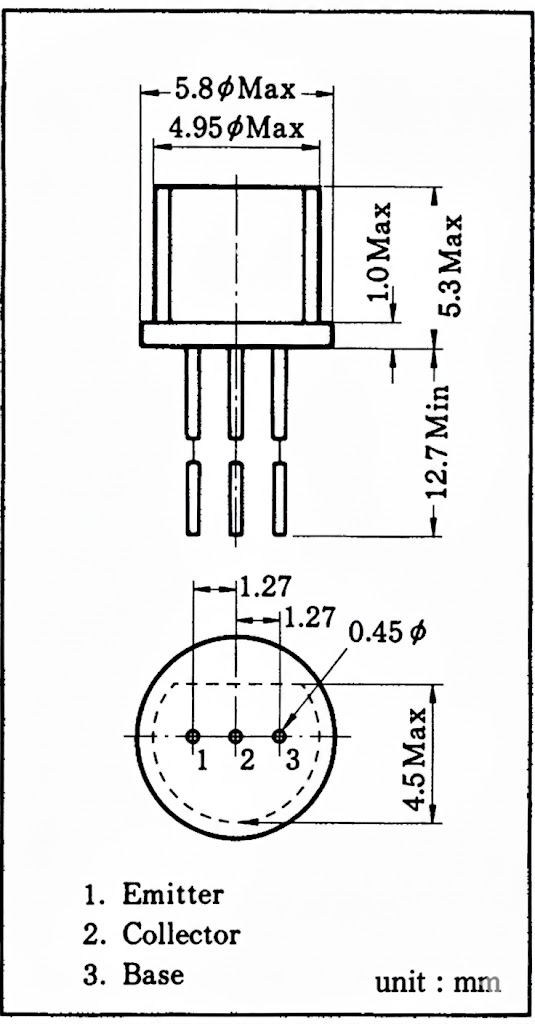
Package: TO-92
Debut: 2SA494 (1971), 2SC369 (1966)
Discontinued: 2SA494 (1976), 2SC369 (1972), 2SA494G (1972), 2SC369G (1976)
Overview
The 2SA494 first appeared in Toshiba’s 1971 Semiconductor Handbook as Japan’s first low-frequency, low-noise PNP silicon transistor in the 2SA series. A higher-voltage version, the 2SA493 (Vcbo=50V), was also developed, but it was released two years later than the 2SA494 despite having an earlier registration number, suggesting development challenges.
The 2SC369 first appeared in Toshiba’s 1966 Semiconductor Handbook as Toshiba’s first “resin-encapsulated” NPN low-frequency, low-noise silicon transistor. It was designed for use in applications such as the first stage of a two-stage direct-coupled RIAA equalizing amplifier.
Both transistors were also available in high-reliability communication-grade versions: 2SA494G and 2SC369G, which were explicitly announced as complementary pairs.
While the standard (non-G) versions of 2SA494/2SC369 are not explicitly described as complementary, their basic characteristics match those of the G-grade versions, suggesting they could functionally serve as complementary pairs.
Given that the 2SC369 was discontinued around the same time the 2SA494 was introduced, and considering circuit design trends of that era, these transistors were more commonly used for level shifting in multi-stage direct-coupled amplifier circuits rather than as complementary pairs.
When the higher-voltage 2SA493/2SC1000 (Vceo=50V) was introduced, the 2SA494/2SC369 lost their relevance and were phased out.
Key Features
2SA494
- Low noise: 2.5dB
- High DC current gain: HFE 70-400
2SC369
- Low noise figure: NF = 3dB (max)
- High current gain: HFE = 200-1200
- High transition frequency: fT = 150MHz (typ)
Specifications
Source:
TOSHIBA Semiconductor Databook 1980/1977
TOSHIBA Semiconductor Handbook 1986/1983/1971/1969/1966
Toshiba Small Signal Transistor SMD 2005
CQ Publishing: Latest Transistor Cross-Reference Tables 1972/1974/1975/1976/1978/1980/1996/2003
For detailed information about CQ Publishing and the reference materials used in this archive, see Reference Materials & Sources.
Maximum Ratings
| Parameter | 2SA494 (1971) | 2SC369 (1969) | 2SC369 (1966) |
|---|---|---|---|
| Manufacturing | SiEP | SiEP | SiEP |
| Vcbo (V) | -35 | 18 | 18 |
| Vceo (V) | -30 | 18 | 18 |
| Vebo (V) | -5 | 5 | 5 |
| Ic (A) | -0.03 | 0.1 | 0.1 |
| Pc (W)*Ta=25℃ | 0.2 | 0.2 | 0.2 |
Electrical Characteristics
| Parameter | 2SA494 (1971) | 2SC369 (1969) | 2SC369 (1966) | |
|---|---|---|---|---|
| HFE | O:70-140 Y:120-240 GR:200-400*Vce=-6V *Ie=-0.1mA | GR:200-400 BL:400-700 V:600-1200*Vce=10V *Ie=-1mA | GR:150-400 BL:250-800*Vce=10V *Ie=-1mA | |
| fT (MHz) | Min.100*Vce=-10V *Ie=-10mA | Typ.150*Vce=10V *Ie=-1mA | Typ.150*Vce=10V *Ie=-1mA | |
| Cob (pF) | – | Typ.1.5*Vcb=10V | Typ.1.5*Vcb=10V | |
| NF (dB) | 120Hz | Typ.1*Vce=-6V *Ie=-20µA *Rg=10kΩ | – | – |
| 1kHz | Typ.2.5 Max.4*Vce=-6V *Ie=-100µA *Rg=10kΩ | Max.8*Vce=5V *Ie=-50µA | Max.8*Vce=5V *Ie=-50µA | |
| 10kHz | Typ.1 Max.2*Vce=-6V *Ie=-100µA *Rg=10kΩ | Max.3*Vce=5V *Ie=-50µA | Max.3*Vce=5V *Ie=-50µA | |
Product History & Cross-Reference
| Item | 2SA494 (1971) | 2SC369 (1969) | 2SC369 (1966) | |
|---|---|---|---|---|
| Maintenance designation | April 1974 | – | – | |
| Discontinued | April 1976 | April 1972 | – | |
| Cross- Reference | Toshiba Databook | 2SA493 2SA842 2SA970 2SA1015 | 2SC732 2SC732TM 2SC1681 2SC1682 2SC2240 | – |
| CQ Publishing | 2SA493 2SA543 2SA629 2SA640 2SA641 2SA666 2SA677 2SA678 2SA701 2SA725 2SA842 2SA930 2SA990 2SA1015 2SA1127 | 2SC403B 2SC423 2SC458LG 2SC476 2SC633A 2SC640 2SC644 2SC732 2SC871 2SC923 2SC933 2SC945L 2SC1084 2SC1312 2SC1740S 2SC2240 2SC2274 2SC2634 | – | |
Early 2SC369
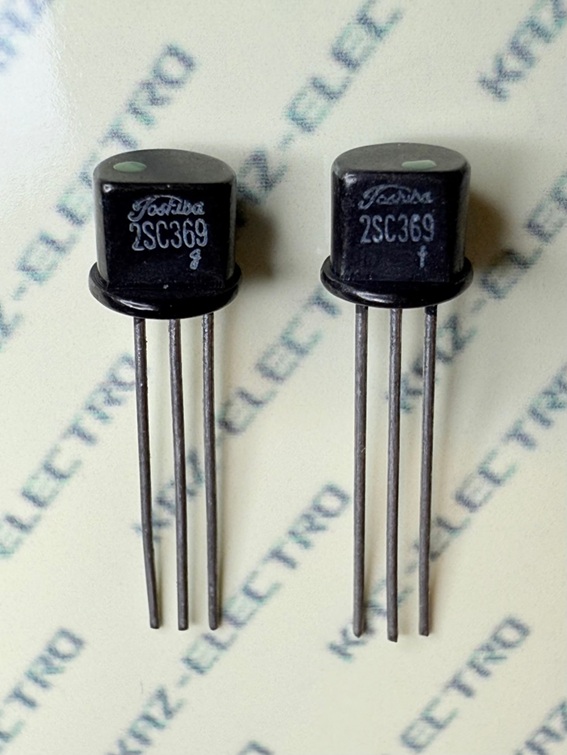
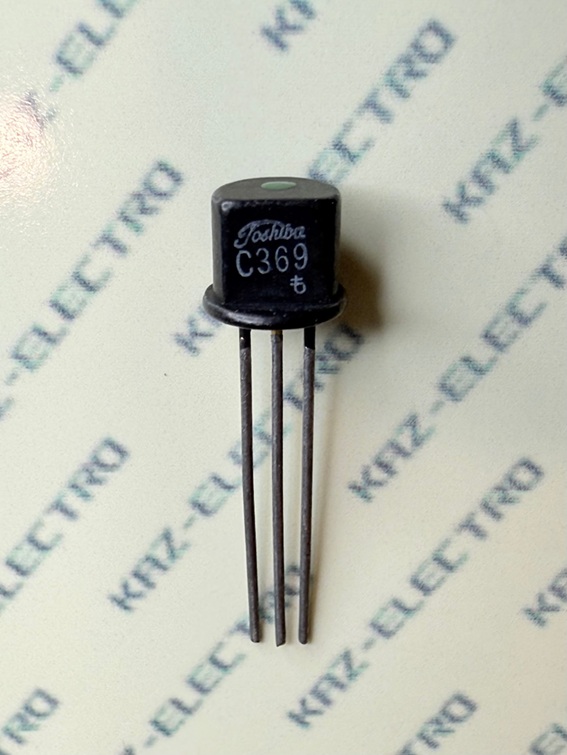
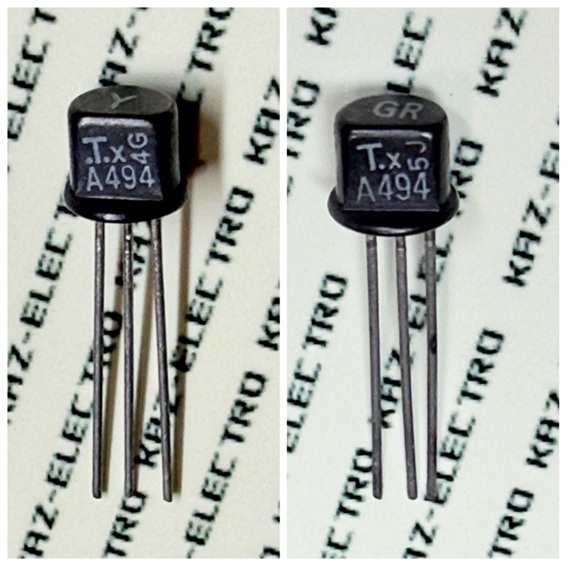
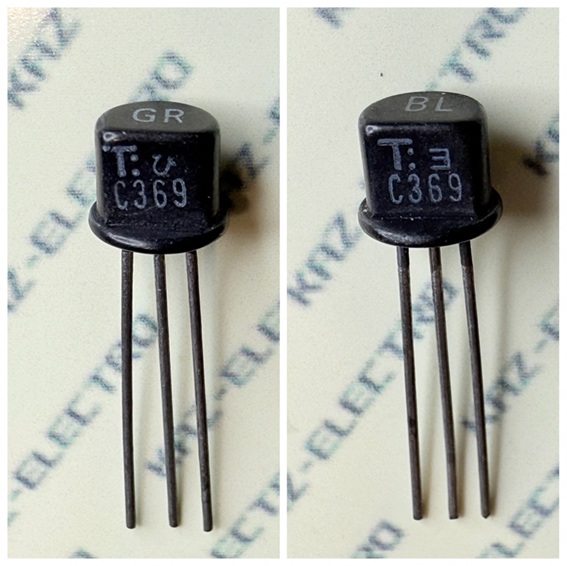
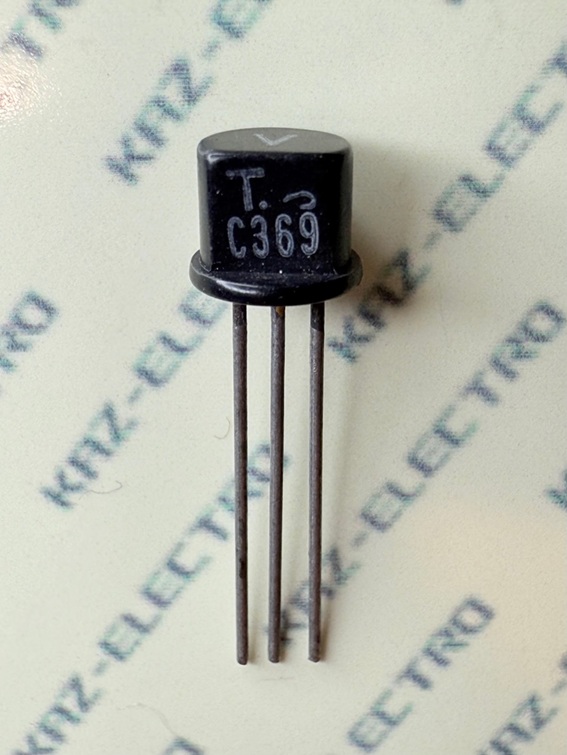
The earliest version features the full part number “2SC369” printed on the device. Lot codes are marked with single lowercase letters such as “f” or “g.”
Some lots use hiragana characters like “も” for lot identification. The “2S” prefix was eventually omitted from later versions.
From the 1960s until 1972, Toshiba used lowercase English letters, hiragana, and katakana for lot markings, making it difficult to determine manufacturing dates. From July 1973 onward, a simpler system was adopted: the last digit of the year + an uppercase letter representing the month (A=January, L=December).
Overview
The 2SA494G and 2SC369G are high-reliability communication-grade versions of the 2SA494 and 2SC369, belonging to Toshiba’s “Communication/Industrial Green Series.”
The 2SA494G had an especially short lifespan—appearing in the 1971 catalog but marked as discontinued by April 1972.
Note: The 2SC369G also had a metal-can TO-18 equivalent, the 2SC368, which appears to be the same chip in a different package based on identical maximum ratings and characteristic curves.
2SA494G
Applications:
- Communication/industrial Green Series (high-reliability grade)
- Low-noise amplification
- Low-level amplification
- High-frequency amplification
- Can be used as complementary pair with 2SC369G series
Features:
- High DC current gain: HFE 70-400
- Low noise:
- NF = 2dB (max) at f=1kHz, Rg=10kΩ
- NF = 2.5dB (typ) at f=120Hz, Rg=10kΩ
2SC369G
Applications:
- Communication/industrial Green Series (high-reliability grade)
- Low-noise amplification
- Low-level amplification
Features:
- Low collector cutoff current: Icbo = 0.1µA (max)
- High DC current gain: HFE 200-1200
- Low noise:
- NF = 2dB (max) at f=1kHz, Rg=10kΩ
- NF = 4dB (typ) at f=120Hz, Rg=10kΩ
Specifications
Source:
TOSHIBA Semiconductor Databook 1980/1977
TOSHIBA Semiconductor Handbook 1986/1983/1971/1969/1966
Toshiba Small Signal Transistor SMD 2005
CQ Publishing: Latest Transistor Cross-Reference Tables 1972/1974/1975/1976/1978/1980/1996/2003
For detailed information about CQ Publishing and the reference materials used in this archive, see Reference Materials & Sources.
Maximum Ratings
| Parameter | 2SA494G (1971) | 2SC369G (1971) | 2SC369G (1969) | 2SC369G (1966) |
|---|---|---|---|---|
| Manufacturing | SiEP | SiEP | SiEP | SiEP |
| Vcbo (V) | -35 | 40 | 18 | 25 |
| Vceo (V) | -30 | 30 | 18 | 18 |
| Vebo (V) | -5 | 5 | 5 | 5 |
| Ic (A) | -0.08 | 0.1 | 0.1 | 0.1 |
| Pc (W)*Ta=25℃ | 0.2 | 0.2 | 0.2 | 0.2 |
Electrical Characteristics
| Parameter | 2SA494G (1971) | 2SC369G (1971) | 2SC369G (1969) | 2SC369G (1966) | |
|---|---|---|---|---|---|
| HFE | O:70-140 Y:120-240 GR:200-400*Vce=-6V *Ie=-0.1mA | GR:200-400 BL:400-700 V:600-1200*Vce=10V *Ie=1mA | GR:150-400 BL:250-800*Vce=10V *Ie=-1mA | GR:150-400 BL:250-800*Vce=10V *Ie=-1mA | |
| fT (MHz) | Min.100 Typ.150*Vce=-10V *Ie=-10mA | Min.50*Vce=10V *Ie=1mA | Min.100 Typ.150*Vce=10V *Ie=-1mA | Min.80 Max.150*Vce=10V *Ie=-1mA | |
| Cob (pF) | Typ.4 Max.7*Vcb=-10V | Typ.1.5*Vcb=10V | Typ.1.5 Max.3.0*Vcb=10V | Typ.1.5 Max.3*Vcb=10V | |
| NF (dB) | 120Hz | Typ.2.5 Max.4*Vce=-5V *Ie=-100µA *Rg=10kΩ | Typ.2.5 Max.4*Vce=5V *Ie=100µA *Rg=10kΩ | Typ.5.0 Max.8.0*Vce=5V *Ie=-50µA *Rg=10kΩ | Typ.5 Max.8*Vce=5V *Ie=-50µA *Rg=10kΩ |
| 1kHz | Typ.1 Max.2*Vce=-5V *Ie=-100µA *Rg=10kΩ | Max.2*Vce=5V *Ie=100µA *Rg=10kΩ | Max.2*Vce=5V *Ie=-50µA *Rg=10kΩ | Typ.1.5 Max.3*Vce=5V *Ie=-50µA *Rg=10kΩ | |
Product History & Cross-Reference
| Item | 2SA494G (1971) | 2SC369G (1971) | 2SC369G (1969) | 2SC369G (1966) | |
|---|---|---|---|---|---|
| Maintenance designation | – | April 1972 | – | – | |
| Discontinued | April 1972 | April 1976 | – | – | |
| Cross- Reference | Toshiba Databook | 2SA493G 2SA493GTM 2SA1015 | 2SC1000G 2SC1000GTM 2SC2240 | – | – |
| CQ Publishing | 2SA493 2SA543 2SA629 2SA640 2SA641 2SA666 2SA677 2SA678 2SA701 2SA725 2SA842 2SA930 2SA990 2SA1015 2SA1127 | 2SC403B 2SC423 2SC458LG 2SC476 2SC633A 2SC640 2SC644 2SC732 2SC871 2SC923 2SC933 2SC945L 2SC1084 2SC1312 2SC1740S 2SC2240 2SC2274 2SC2634 | – | – | |
Communication/Industrial Green Series
The “Communication/Industrial Green Series” was Toshiba’s designation for high-reliability transistors intended for professional equipment and industrial applications.
The Green Series transistors share the same model numbers as general-grade versions but undergo additional processing to ensure reliability. This includes:
- Temperature cycling and thermal aging or power aging during manufacturing to stabilize characteristics
- Removal of early failures to reduce defect rates
- Testing and inspection at nearly the same standards as full-specification communication/industrial transistors
- Testing according to U.S. military standards (MIL-SPEC equivalent) to verify quality
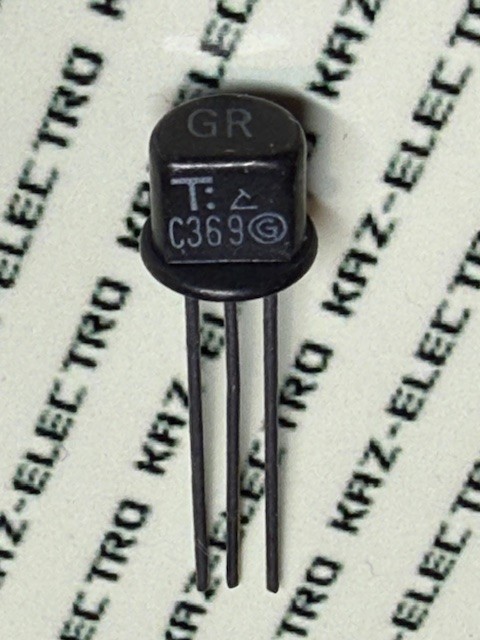
Green Series transistors are designated with a “G” suffix and marked with a “G” symbol on the device body to distinguish them from general-grade versions.
The basic characteristic of current gain (HFE or hfe) is subdivided for circuit design convenience and compatibility, indicated by color dots or color-coded letters on the package head:
- O (Orange): 70-140
- Y (Yellow): 120-240
- GR (Green): 200-400
- BL (Blue): 350-700
- V (Violet): 600-1200
Complementary Pair Status
The standard (non-G) versions of 2SA494 and 2SC369 were not explicitly described as complementary pairs, since the NPN 2SC369 was discontinued shortly before the PNP 2SA494 was introduced.
However, the communication-grade Green Series versions (2SC369G and 2SA494G) overlapped briefly between 1970 and 1972, during which time they were explicitly marketed as complementary pairs for use in matched PNP/NPN applications.